
Neurodiversity & Inclusive Workplaces
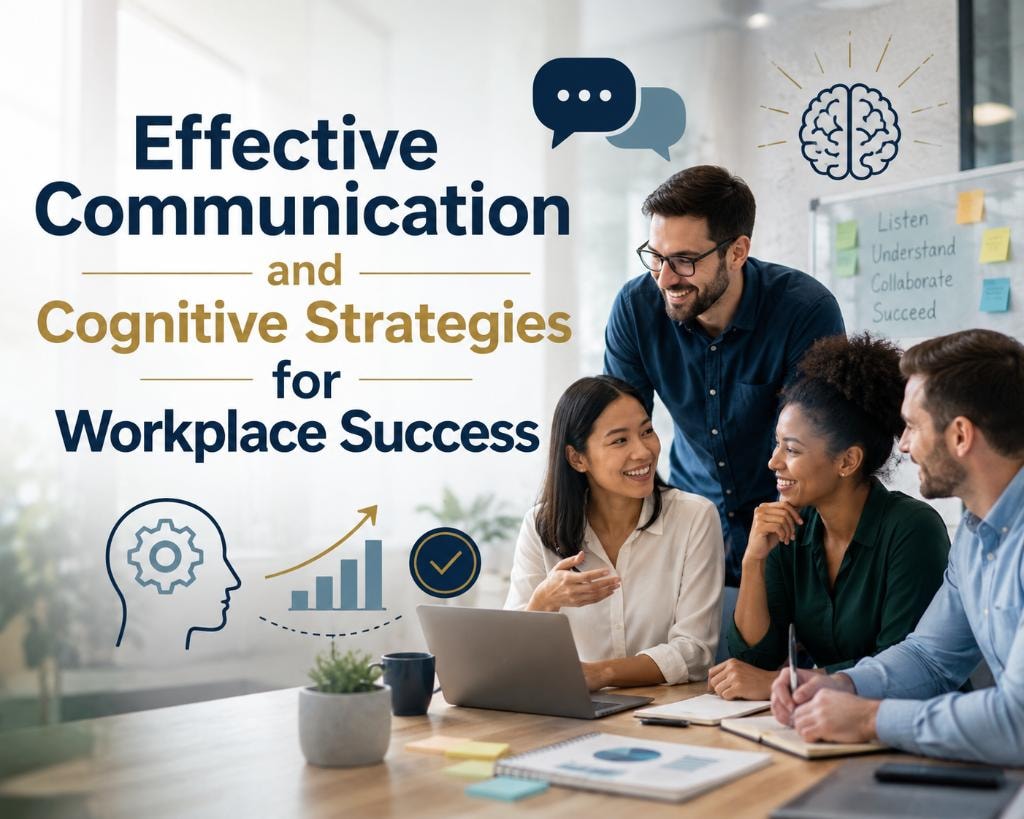
Effective Communication and Cognitive Strategies for Workplace Success
By Kim Kewney
Founder & Executive Director · The Mindset Matrix Institute™
Originally published January 2025 · 8–10 minute read
Publication Note: This article was originally published in January 2025has been reformatted for publication by The Mindset Matrix Institute™. The original content has not been substantively altered.
In today's diverse workplaces, effective communication is more than a professional skill — it is a foundational competency that determines whether individuals, teams, and organizations thrive or struggle. When communication breaks down, productivity suffers, relationships erode, and the full potential of every person in the organization goes unrealized.
This is especially true in neurodiverse workplaces, where individuals bring a wide range of cognitive styles, communication preferences, and processing approaches. Understanding how to communicate effectively across these differences — and how to apply cognitive strategies that support sustained performance — is one of the most valuable investments any professional can make.
Why Effective Communication Matters
Effective communication is the foundation of every successful workplace relationship. It enables teams to align on goals, navigate conflict constructively, share knowledge efficiently, and build the trust that makes sustained collaboration possible. When communication is unclear, inconsistent, or inaccessible, even the most talented teams underperform.
Research consistently shows that organizations with strong communication cultures outperform their peers on nearly every measure — from employee engagement and retention to innovation and customer satisfaction. Communication is not a soft skill. It is a strategic capability.
Leadership Insight
"Communication is not a soft skill. It is a strategic capability — and in the neurodiverse workplace, it is the difference between potential realized and potential lost."
The Mindset Matrix Institute™
Reflection Questions
Before exploring the strategies in this publication, take a moment to reflect on your own communication experience:
Reflection Prompts
- When have you felt most clearly understood at work? What made that communication effective?
- Where do you notice the most friction in your workplace communication — and what patterns do you observe?
- How do you currently adapt your communication style to meet the needs of different colleagues?
- What is one communication habit you would like to strengthen in the next 30 days?
Challenges in the Workplace
Communication challenges in the workplace are rarely the result of bad intentions. More often, they arise from differences in cognitive style, sensory processing, communication preference, and the unspoken assumptions that people bring to every interaction.
In neurodiverse workplaces, these challenges are amplified. An employee with ADHD may struggle to filter out environmental distractions during a meeting. A colleague with autism may interpret figurative language literally, leading to misunderstandings that neither party intended. A team member with dyslexia may process written instructions more slowly, not because of a lack of capability, but because of a difference in how information is received and organized.
Understanding these differences — and designing communication practices that accommodate them — is not a concession to weakness. It is a recognition that diverse cognitive styles are a source of organizational strength, and that unlocking that strength requires intentional, inclusive communication.
The Impact of Communication
The way we communicate shapes every dimension of the workplace experience. Clear, respectful, and inclusive communication builds psychological safety — the foundation of high-performing teams. Poor communication, by contrast, creates confusion, erodes trust, and generates the kind of chronic low-level stress that depletes cognitive resources and undermines performance over time.
The impact is not limited to individual interactions. Communication patterns become cultural norms. When leaders model clear, empathetic, and inclusive communication, they set the standard for how everyone in the organization communicates. When they don't, the gap between stated values and lived experience widens — and with it, disengagement grows.
Reflection Prompt
"Think of a time when unclear communication created a significant problem at work. What was the cost — to the project, to the relationship, to the team? What would have been different with clearer communication from the start?"
Practical Communication Strategies
The following four strategies form a practical communication framework that can be applied immediately, at any level of the organization, in any workplace context.
Communication Framework
Be Clear and Direct
Avoid ambiguity, jargon, and figurative language that may be interpreted differently by different people. State expectations, deadlines, and outcomes explicitly. When in doubt, confirm understanding by asking the other person to summarize what they heard.
Practice Active Listening
Active listening means giving your full attention to the speaker — not formulating your response while they are still talking. It means reflecting back what you heard, asking clarifying questions, and demonstrating through your body language and responses that you are genuinely engaged.
Leverage Visual and Written Support
For many people — and especially for those with neurodiverse cognitive styles — verbal communication alone is insufficient. Supplement spoken instructions with written summaries, visual aids, diagrams, or checklists. This is not accommodation — it is good communication practice for everyone.
Foster Open Feedback Loops
Create regular, structured opportunities for feedback — not just top-down performance reviews, but genuine two-way dialogue about how communication is working and where it can improve. Psychological safety is the prerequisite: people must feel safe to say "I didn't understand that" or "that approach doesn't work for me."
Cognitive Strategies for Workplace Success
Effective communication is inseparable from cognitive performance. When our cognitive resources are depleted — by stress, overload, or environments that don't accommodate our processing style — our ability to communicate clearly and listen effectively diminishes. The following strategies support cognitive performance for both employees and managers.
For Employees
Chunk Tasks
Break large, complex tasks into smaller, discrete steps. This reduces cognitive load, makes progress visible, and creates natural checkpoints for review and adjustment. For individuals with ADHD or executive function differences, task chunking is not a workaround — it is a high-performance strategy.
Time Management
Use structured time management approaches — time blocking, the Pomodoro technique, or calendar-based task scheduling — to create predictable rhythms that support sustained focus. Protect your highest-cognitive-demand work for the times of day when your attention is sharpest.
Energy Awareness
Recognize that cognitive energy is a finite resource. Track your energy patterns across the day and week, and schedule tasks accordingly. Protect recovery time — breaks, movement, and transitions between tasks are not luxuries; they are performance investments.
For Managers
Flexible Work Approaches
Recognize that a single work structure does not serve all cognitive styles equally. Where possible, offer flexibility in how, when, and where work is done. Flexibility is not a benefit — it is a performance enabler that allows each person to do their best work in the way that works best for them.
Leveraging Individual Strengths
Invest time in understanding the unique cognitive strengths of each team member. Assign work in ways that allow people to lead with their strengths while building their capacity in areas of development. Strength-based management is not just more humane — it is more effective.
Managing Negative Thoughts
Cognitive performance is not only about task management and time structure — it is also about the internal narrative we carry into every interaction. Negative thought patterns — self-doubt, catastrophizing, rumination — consume cognitive resources and undermine both communication and performance. The following strategies support a more constructive internal orientation.
Cognitive Reframing Strategies
Reframe Negative Thoughts
When a negative thought arises, pause and ask: "Is this thought accurate? Is it helpful? What would I say to a colleague who had this thought?" Reframing is not denial — it is the practice of choosing a more accurate and constructive interpretation.
Focus on Controllables
Direct your attention and energy toward what you can influence. Identify the specific actions within your control and take them. Release, as much as possible, the energy spent on outcomes you cannot determine.
Practice Gratitude
A regular gratitude practice — even as simple as noting three specific things you are grateful for at the end of each day — has been shown to shift cognitive and emotional orientation in measurable ways, reducing rumination and increasing resilience.
Redirect "What If" Thinking
"What if" thinking — catastrophizing about future outcomes — is one of the most common and most energy-draining cognitive patterns. When you notice it, redirect: "What is actually happening right now? What is the most likely outcome? What is one constructive step I can take?"
Adopt Mindfulness
Mindfulness — the practice of bringing deliberate, non-judgmental attention to the present moment — is one of the most well-researched cognitive performance tools available. Even brief daily practice (five to ten minutes) has been shown to improve attention, reduce stress reactivity, and enhance emotional regulation.
Problem-Solve Strategically
When facing a challenge, resist the pull toward rumination or avoidance. Instead, apply a structured problem-solving approach: define the problem clearly, identify possible responses, evaluate each option, choose one, act, and review. Strategic problem-solving converts anxiety into agency.
Fostering an Inclusive Culture
Inclusive culture is not built through policy alone — it is built through the daily practices of communication, recognition, and belonging. When every person in an organization feels that their cognitive style, communication preference, and way of working is understood and valued, the conditions for genuine inclusion are in place.
Leaders play a disproportionate role in shaping inclusive culture. When leaders model curiosity about difference, adapt their communication to meet the needs of their team, and create structures that accommodate diverse cognitive styles, they signal that inclusion is not a program — it is a practice.
Inclusive culture also requires that organizations examine and redesign the systems and structures that inadvertently disadvantage neurodiverse employees — from hiring and onboarding practices to meeting formats, performance evaluation criteria, and physical workspace design.
Reflection Prompt
"What is one structural or cultural practice in your organization that may inadvertently disadvantage neurodiverse employees? What would it look like to redesign it with inclusion as the starting point?"
Neurodiversity in Action
The following scenario illustrates how the communication and cognitive strategies in this publication can be applied in a real workplace context.
Workplace Scenario
A Team Meeting Redesigned for Inclusion
A project team of eight people — including two employees with ADHD, one with autism, and one with dyslexia — has been struggling with their weekly team meetings. Attendance is inconsistent, follow-through on action items is poor, and several team members have privately expressed that they find the meetings overwhelming or confusing.
The team leader, drawing on the communication and cognitive strategies in this publication, makes the following changes:
- A written agenda is distributed 24 hours before each meeting, with clear objectives and expected outcomes for each item.
- Meetings are structured with explicit time limits for each agenda item, reducing open-ended discussion that can be difficult to follow.
- A written summary of decisions and action items is distributed within two hours of each meeting.
- Team members are invited to contribute agenda items and questions in writing before the meeting, accommodating those who process better in writing than in real-time verbal discussion.
- The meeting environment is adjusted to reduce sensory distractions — consistent lighting, reduced background noise, and a predictable room setup.
Within four weeks, meeting attendance improves, action item completion rates increase, and three team members independently report feeling more confident and included in team discussions. The changes required no additional budget — only intentionality.
Key Takeaways
- Effective communication is a strategic capability, not a soft skill — and it is the foundation of every high-performing team.
- Neurodiverse workplaces require intentional, inclusive communication practices that accommodate a range of cognitive styles and processing preferences.
- The four-part communication framework — Be Clear and Direct, Practice Active Listening, Leverage Visual and Written Support, Foster Open Feedback Loops — can be implemented immediately at any level of the organization.
- Cognitive strategies for employees (task chunking, time management, energy awareness) and managers (flexible work approaches, strength-based management) support sustained performance across diverse cognitive styles.
- Managing negative thought patterns — through reframing, focusing on controllables, gratitude, mindfulness, and strategic problem-solving — is a core cognitive performance competency.
- Inclusive culture is built through daily practices of communication, recognition, and belonging — not through policy alone.
- Small, intentional changes to communication structures and workplace design can produce measurable improvements in engagement, performance, and inclusion.
Call to Action
The strategies in this publication are not theoretical — they are practical tools that can be applied immediately, in any workplace, at any level of the organization. The question is not whether you have the resources to implement them. The question is whether you have the intention.
Choose one strategy from this publication and commit to practicing it consistently for the next 30 days. Observe what changes — in your own communication, in your team's dynamics, in the quality of your relationships at work. Then choose another.
Meaningful change in workplace communication does not require a program or a budget. It requires one person — you — deciding to show up differently, starting today.
Your Next Step
"Which one strategy from this publication will you commit to practicing for the next 30 days — and how will you know, at the end of that period, whether it made a difference?"
Write it down. Share it with a colleague. Return to it in 30 days. That single act of intentionality is where lasting change begins.
Suggested Reading
Essential Reading
- Armstrong, T. (2010). Neurodiversity: Discovering the Extraordinary Gifts of Autism, ADHD, Dyslexia, and Other Brain Differences. Da Capo Lifelong Books.
- Brown, B. (2018). Dare to Lead: Brave Work. Tough Conversations. Whole Hearts. Random House.
- Edmondson, A. C. (2018). The Fearless Organization: Creating Psychological Safety in the Workplace for Learning, Innovation, and Growth. Wiley.
- Goleman, D. (1995). Emotional Intelligence: Why It Can Matter More Than IQ. Bantam Books.
- Patterson, K., Grenny, J., McMillan, R., & Switzler, A. (2011). Crucial Conversations: Tools for Talking When Stakes Are High. McGraw-Hill.
- Rock, D. (2009). Your Brain at Work: Strategies for Overcoming Distraction, Regaining Focus, and Working Smarter All Day Long. HarperBusiness.
Resources
Workplace Tools & Support Networks
- CHADD (Children and Adults with Attention-Deficit/Hyperactivity Disorder) — chadd.org — Resources for individuals and organizations navigating ADHD in the workplace.
- Autism Society of America — autism-society.org — Workplace inclusion resources and employer guidance.
- International Dyslexia Association — dyslexiaida.org — Workplace accommodation resources and professional development tools.
- SHRM (Society for Human Resource Management) — shrm.org — Neurodiversity in the workplace resources, including hiring guides and accommodation frameworks.
- Job Accommodation Network (JAN) — askjan.org — Free consulting service providing guidance on workplace accommodations for employees with disabilities and neurodiverse conditions.
© 2025 Kim Kewney / The Mindset Matrix Institute™. All rights reserved. Originally published January 2025, 2025. This article may not be reproduced, distributed, or transmitted in any form without prior written permission.
About the Author

Kim Kewney
Founder & Executive Director · The Mindset Matrix Institute™
Kim Kewney is the Founder of The Mindset Matrix Institute™, where she works with individuals, families, leaders, educators, and organizations to create meaningful, lasting change through an evidence-informed approach to human development. Her work integrates neuroscience, leadership, emotional intelligence, and organizational transformation into one cohesive framework.
Meet The Founder →Continue Exploring
More from The Knowledge Library
This publication bridges several of The Institute's core themes. Related publications you may find valuable: