
Leadership & Organizational Transformation
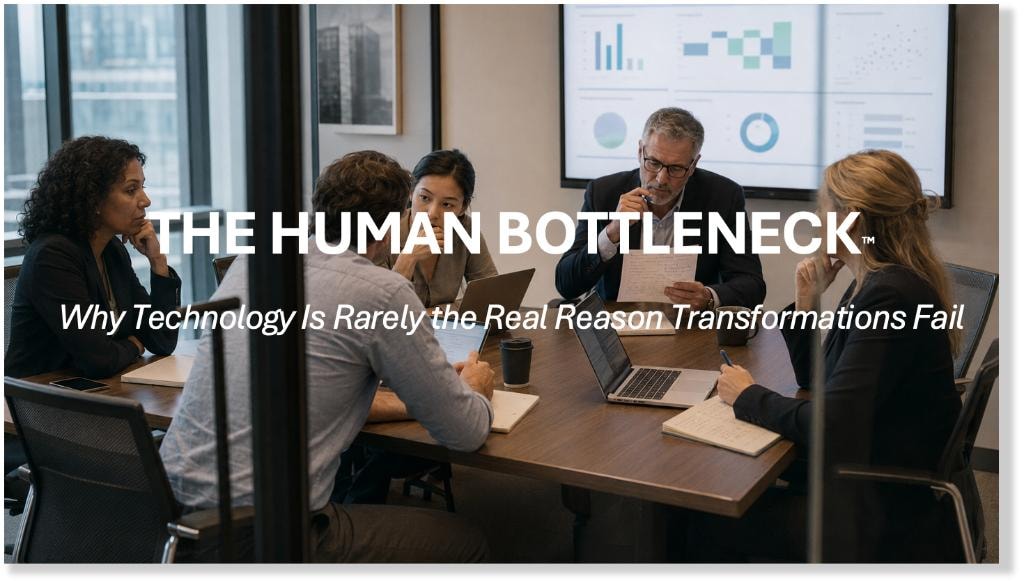
The Human Bottleneck™
Why Technology Is Rarely the Real Reason Transformations Fail
By Kim Kewney
Founder & Executive Director · The Mindset Matrix Institute™
Thought Leadership Series
Originally published July 2026 · 12–15 minute read
Publication Note: This article was originally published in July 2026. The original content has not been substantively altered.
Every year, organizations invest billions of dollars in technology designed to make them faster, smarter, more efficient, and more competitive. Enterprise resource planning systems. Customer relationship management platforms. Artificial intelligence tools. Workflow automation. Digital collaboration infrastructure. The list grows longer and the investments grow larger with every passing year.
And yet, the failure rate of major transformation initiatives remains stubbornly high.
Depending on the study you reference, somewhere between 60 and 80 percent of large-scale digital and organizational transformation efforts fail to deliver their intended outcomes — on time, on budget, or at all. Some fail quietly, producing systems that are technically functional but practically unused. Others fail loudly, consuming years of organizational energy and leaving behind confusion, cynicism, and a workforce that has learned not to trust the next initiative.
When these failures are examined, the technology itself is rarely the primary culprit.
The systems work. The platforms function. The tools do what they were designed to do.
What fails — almost universally — is the human infrastructure surrounding the technology. The leadership alignment. The communication clarity. The trust between teams. The organizational culture. The change management. The emotional readiness of the people being asked to work differently.
This is what I call The Human Bottleneck™.
What Is The Human Bottleneck™?
Core Concept
"Technology doesn't cause transformation to fail. It exposes the human challenges that were already there."
The Mindset Matrix Institute™
The Human Bottleneck™ is the point in any transformation process where human factors — not technical ones — become the primary constraint on progress, adoption, and sustainable change.
It is the moment when a new system is live but no one is using it correctly. When a new process has been documented but the team is still doing things the old way. When leadership has announced the change but hasn't modeled it. When the training has been delivered but the culture hasn't shifted. When the technology is ready but the people aren't.
The Human Bottleneck™ is not a failure of intelligence or effort. It is a predictable consequence of treating transformation as a technical problem when it is fundamentally a human one.
Understanding where the bottleneck forms — and why — is the first step toward building transformation strategies that actually work.
Where the Bottleneck Forms
The Human Bottleneck™ does not appear randomly. It forms predictably in five interconnected areas. Each one is worth examining carefully, because each one requires a different kind of organizational response.
The Five Formation Points
1. Leadership Misalignment
Transformation initiatives frequently stall because the leaders responsible for driving them are not genuinely aligned — with each other, with the strategy, or with the behaviors the change requires. When senior leaders say the right things in all-hands meetings but continue operating as they always have, the organization takes its cues from behavior, not messaging. Misalignment at the top creates confusion, skepticism, and passive resistance throughout the organization.
2. Communication Breakdown
Most transformation communication is designed to inform rather than to engage. Organizations announce what is changing, explain why it is changing, and provide timelines and training schedules. What they rarely do is create genuine two-way dialogue — space for questions, concerns, confusion, and honest feedback. When people don't understand the "why" at a personal level, or when they feel their concerns are not being heard, they disengage. And disengaged people do not drive transformation forward.
3. Trust Deficits
Trust is the invisible infrastructure of every successful transformation. When trust is high — between leaders and teams, between departments, between the organization and its people — change moves faster, adoption is higher, and setbacks are absorbed more easily. When trust is low, every new initiative is filtered through a lens of skepticism. People wonder what is really behind the change. They protect their territory. They wait to see what happens to the early adopters before committing themselves.
4. Cultural Resistance
Culture is not a set of values on a wall. It is the sum of the behaviors that are rewarded, tolerated, and punished within an organization every day. When a transformation initiative requires behaviors that the existing culture does not support — transparency, experimentation, cross-functional collaboration, accountability — the culture will win. Not because people are obstinate, but because culture is the operating system the organization runs on. Changing the application without updating the operating system produces predictable results.
5. Emotional Unreadiness
Change is emotionally demanding. It requires people to let go of familiar ways of working, accept uncertainty, develop new competencies, and tolerate the discomfort of not yet being proficient at something new. Organizations that treat this emotional dimension as irrelevant — or as something to be managed through cheerful messaging — consistently underestimate the time and support required for genuine adoption. People need to feel safe enough to struggle, ask questions, and make mistakes before they can truly embrace something new.
Why Technology Gets the Blame
When a transformation initiative fails, the post-mortem conversation often focuses on the technology. The system was too complex. The implementation was rushed. The vendor overpromised. The integration didn't work as expected.
These critiques are sometimes valid. But they are rarely the whole story — and they are almost never the primary story.
Technology gets the blame for several reasons, none of which have much to do with the technology itself.
First, technology is concrete and visible. It is easier to point to a system that people aren't using than to name the leadership behaviors that made adoption feel unsafe. It is easier to critique a platform than to acknowledge that the organization's culture actively punishes the transparency the platform was designed to enable.
Second, blaming technology protects people. When the system is the problem, no one has to examine their own role in the failure. No one has to ask whether the leadership team was genuinely aligned, whether the communication strategy created real understanding, or whether the organization's trust levels were sufficient to support the change being asked of people.
Third, technology is replaceable. If the system failed, you can buy a better one. This narrative is comfortable because it suggests the solution is a procurement decision rather than a cultural or leadership one. It preserves the belief that the next initiative will succeed if you just choose the right platform.
Key Insight
"If the human infrastructure isn't ready, a better system will fail just as reliably as the last one."
The Mindset Matrix Institute™
It rarely does. Because if the human infrastructure isn't ready — if the leadership isn't aligned, the communication isn't genuine, the trust isn't there, the culture doesn't support the change, and the people aren't emotionally prepared — a better system will fail just as reliably as the last one.
What Successful Transformation Actually Requires
Organizations that navigate transformation successfully share a set of characteristics that have very little to do with the sophistication of their technology stack and a great deal to do with the quality of their human infrastructure.
Leadership That Models the Change
In successful transformations, senior leaders don't just sponsor the initiative — they visibly embody it. They use the new systems. They ask questions in public. They acknowledge what they don't yet know. They demonstrate that the behaviors the transformation requires are safe to practice, even at the top of the organization.
This is not a communications strategy. It is a behavioral commitment. And it is the single most powerful signal an organization can send about whether a transformation is real.
Communication That Creates Understanding, Not Just Awareness
There is a meaningful difference between telling people what is changing and helping them understand why it matters to them personally. Successful transformation communication answers the questions people are actually asking — not the questions leadership wishes they were asking.
What does this mean for my role? What will be different about how I work? What happens if I struggle with the transition? Is my job secure? Does leadership actually believe in this, or is this another initiative that will quietly disappear in six months?
Organizations that answer these questions honestly — even when the honest answer is "we don't know yet" — build the credibility required for genuine engagement.
Trust as a Strategic Asset
Trust is not a soft concept. It is a measurable organizational capability that directly affects the speed and cost of change. High-trust organizations move faster, experience less resistance, and recover from setbacks more effectively than low-trust ones.
Building trust requires consistency between what leaders say and what they do. It requires transparency about decisions and their rationale. It requires accountability when things go wrong. And it requires genuine investment in the well-being and development of the people being asked to change.
Organizations that treat trust as a prerequisite for transformation — rather than a nice-to-have — consistently outperform those that don't.
Culture That Supports the Required Behaviors
Before launching a transformation initiative, it is worth asking a direct question: Does our current culture reward the behaviors this transformation requires?
If the transformation requires cross-functional collaboration but the culture rewards individual performance, there is a structural conflict that no amount of training will resolve. If the transformation requires psychological safety to experiment and fail, but the culture punishes mistakes, people will protect themselves rather than innovate.
Identifying these conflicts before launch — and addressing them explicitly — is not a detour from the transformation. It is the transformation.
Emotional Support for the Transition
Change is a loss experience before it is a gain experience. Even positive change requires people to let go of something familiar — a way of working, a sense of competence, a set of relationships, an identity tied to a particular role or expertise.
Organizations that acknowledge this — that create space for the grief, confusion, and frustration that accompany genuine change — move through transitions more effectively than those that insist on relentless positivity. People don't need to be told that change is exciting. They need to feel that their experience of it is understood.
The Human Bottleneck™ Diagnostic
Before investing in the next transformation initiative — or before diagnosing why the current one is stalling — consider the following diagnostic questions. They are not exhaustive, but they are revealing.
Diagnostic Questions
Leadership Alignment
- Are the senior leaders sponsoring this initiative genuinely aligned on the strategy, the timeline, and the behaviors required?
- Are they visibly modeling the change they are asking others to make?
- Are they willing to be publicly accountable when the initiative encounters difficulty?
Communication Quality
- Do people at every level of the organization understand why this change is happening — not just what is changing?
- Is there a genuine mechanism for questions, concerns, and feedback to reach decision-makers?
- Are the answers people receive honest, even when the honest answer is uncertain?
Trust Levels
- Do people trust that leadership's stated intentions reflect their actual intentions?
- Is there sufficient trust between teams and departments to enable the collaboration this transformation requires?
- Have previous transformation initiatives been handled in ways that built or eroded trust?
Cultural Alignment
- Does the current culture reward the behaviors this transformation requires?
- Are there structural conflicts between the existing culture and the change being asked of people?
- Has the organization explicitly addressed these conflicts, or is it hoping the new system will resolve them?
Emotional Readiness
- Have people been given adequate time, support, and space to process the emotional dimensions of this change?
- Is it safe to struggle, ask questions, and make mistakes during the transition?
- Are managers equipped to support their teams through the emotional experience of change — not just the operational one?
If the honest answers to these questions reveal significant gaps, the organization has identified its Human Bottleneck™. The technology is not the problem. The human infrastructure is — and that is where the investment needs to go.
What This Means for Leaders
If you are a leader responsible for a transformation initiative — whether it is a technology implementation, a cultural shift, a structural reorganization, or an AI adoption strategy — the most important question you can ask is not "Is the technology ready?" It is "Are the people ready?"
And readiness, in this context, is not about training completion rates or system access. It is about whether the human conditions for successful change are in place: alignment, communication, trust, cultural support, and emotional safety.
This requires a different kind of leadership than most transformation programs are designed to develop. It requires leaders who can hold complexity — who can manage the operational demands of a major change initiative while simultaneously attending to the human experience of the people living through it.
It requires emotional intelligence. It requires the ability to build and sustain trust under pressure. It requires communication skills that go beyond messaging and into genuine dialogue. It requires the courage to name what isn't working before it becomes a crisis.
These are not soft skills. They are the hard skills of transformation leadership — and they are the ones most frequently underdeveloped, underinvested, and undervalued in organizations that wonder why their transformations keep failing.
A Different Starting Point
The organizations that navigate transformation most successfully are not the ones with the most sophisticated technology. They are the ones that treat the human dimensions of change with the same rigor, investment, and strategic attention they give to the technical ones.
They assess their human infrastructure before they launch. They invest in leadership development that builds the specific capabilities transformation requires. They create communication strategies designed for genuine understanding, not just awareness. They build trust deliberately and protect it carefully. They design cultures that support the behaviors they need. And they acknowledge the emotional reality of change rather than papering over it with enthusiasm.
This is not a slower approach to transformation. It is a faster one — because it eliminates the rework, the resistance, the failed adoptions, and the organizational cynicism that make every subsequent initiative harder to launch.
The Core Principle
"Transformation is not a technology problem. It is a human endeavor. And human endeavors require human leadership."
The Mindset Matrix Institute™
The Human Bottleneck™ is not inevitable. It is predictable — which means it is preventable. But preventing it requires organizations to stop treating transformation as a technology problem and start treating it as what it actually is: a human endeavor that requires human leadership, human investment, and a genuine commitment to the people being asked to change.
The technology will be ready when you need it. The question is whether the people will be.
Further Reading & Practical Resources
The following resources offer additional depth on the themes explored in this article. They are drawn from peer-reviewed research, practitioner literature, and organizational case studies.
On Transformation Failure Rates
- McKinsey & Company. (2023). Why do most transformations fail? A conversation with Harry Robinson. McKinsey Quarterly.
- Kotter, J. P. (1995). Leading change: Why transformation efforts fail. Harvard Business Review, 73(2), 59–67.
- Prosci. (2023). Best practices in change management (12th ed.). Prosci Inc.
On Leadership and Change
- Heifetz, R., Grashow, A., & Linsky, M. (2009). The practice of adaptive leadership. Harvard Business Press.
- Kegan, R., & Lahey, L. L. (2016). An everyone culture: Becoming a deliberately developmental organization. Harvard Business Review Press.
- Edmondson, A. C. (2018). The fearless organization: Creating psychological safety in the workplace for learning, innovation, and growth. Wiley.
On Trust and Organizational Culture
- Covey, S. M. R. (2006). The speed of trust: The one thing that changes everything. Free Press.
- Schein, E. H., & Schein, P. A. (2017). Organizational culture and leadership (5th ed.). Wiley.
- Zak, P. J. (2017). The neuroscience of trust. Harvard Business Review, 95(1), 84–90.
On Emotional Intelligence and Change Readiness
- Goleman, D. (1995). Emotional intelligence: Why it can matter more than IQ. Bantam Books.
- Bridges, W., & Bridges, S. (2016). Managing transitions: Making the most of change (4th ed.). Da Capo Lifelong Books.
- Rock, D. (2008). SCARF: A brain-based model for collaborating with and influencing others. NeuroLeadership Journal, 1(1), 44–52.
On Digital and AI Transformation
- Westerman, G., Bonnet, D., & McAfee, A. (2014). Leading digital: Turning technology into business transformation. Harvard Business Review Press.
- Davenport, T. H., & Mittal, N. (2023). All-in on AI: How smart companies win big with artificial intelligence. Harvard Business Review Press.
- MIT Sloan Management Review & Deloitte Insights. (2023). Expanding AI's impact with organizational learning.
Source Notes
The transformation failure rate statistics cited in this article (60–80%) are drawn from a range of practitioner and research sources, including McKinsey & Company, Prosci, and Harvard Business Review. Specific figures vary by study, industry, and definition of "failure." The range cited reflects the consistent finding across multiple sources that the majority of large-scale transformation initiatives do not achieve their intended outcomes.
The Human Bottleneck™ framework is an original conceptual model developed by Kim Kewney and The Mindset Matrix Institute™. It synthesizes established research in organizational behavior, change management, leadership development, emotional intelligence, and organizational psychology into a practical diagnostic and strategic framework for transformation leaders.
The five formation points described in this article — leadership misalignment, communication breakdown, trust deficits, cultural resistance, and emotional unreadiness — are grounded in the practitioner and academic literature cited in the Further Reading section above. They are not presented as an exhaustive taxonomy of transformation challenges but as the most consistently documented and practically significant human factors in transformation failure.
Use This Article With Your Team
This article is designed to be used as a leadership development resource, a team discussion catalyst, or a pre-initiative diagnostic tool. Consider the following applications:
- Share the Human Bottleneck™ Diagnostic with your leadership team before launching a major initiative. Use the questions as a structured conversation rather than a checklist.
- Use the Five Formation Points as a framework for a post-mortem on a previous transformation initiative. Where did the bottleneck form? What would you do differently?
- Facilitate a team discussion on trust: What is the current trust level within your team? Between your team and senior leadership? What has built or eroded trust in the past year?
- Invite honest conversation about emotional readiness: What are people most anxious about in the current or upcoming change? What support would make the transition feel safer?
- Review your communication strategy through the lens of this article: Are you informing people or genuinely engaging them? Are you answering the questions they are actually asking?
If your organization is navigating a significant transformation and would benefit from executive coaching, leadership development, or organizational consulting support, The Mindset Matrix Institute™ offers engagements designed specifically for leaders and teams in the middle of meaningful change.
About the Author
Kim Kewney
Founder & Executive Director · The Mindset Matrix Institute™
Kim Kewney is the Founder and Executive Director of The Mindset Matrix Institute™, where she works with executives, leaders, teams, and organizations navigating meaningful change. Her work integrates executive coaching, leadership development, organizational consulting, and executive education to help individuals and organizations build the human infrastructure that lasting transformation requires.
Kim holds certifications in Emotional Intelligence, Trauma Healing Coaching, and Neurodiversity Coaching, and brings a deeply human-centered perspective to the challenges of organizational transformation, leadership effectiveness, and sustainable change.
© 2026 The Body Refinery, LLC d/b/a The Mindset Matrix Institute™. All rights reserved. The Human Bottleneck™ is a trademark of The Mindset Matrix Institute™. This article may be shared for educational and professional development purposes with attribution. It may not be reproduced, republished, or distributed in whole or in part without written permission from The Mindset Matrix Institute™.